This page lists my papers, tools, and datasets on AI-generated disinformation, with links to the blog posts about them. I update it as new work appears.
The research began during my time in Microsoft’s AI for Good Lab and became my doctoral project in January 2024, co-supervised by Prof. Martin Kappes (Frankfurt University of Applied Sciences) and Prof. Marc-Oliver Pahl (IMT Atlantique, Chaire Cyber CNI). On September 30, 2026, I submitted the dissertation, The AI-Driven Disinformation Ecosystem: Measurement Validity Across Generation, Perception, Detection, and Mitigation.
The question
Large language models can write news texts that readers struggle to tell apart from human writing. The work looks at what this means at four stages:
- Generation: how AI-generated news can be produced under controlled, documented conditions for research.
- Human perception: whether people recognize AI-generated news, and which factors relate to their accuracy.
- Machine detection: whether detectors recognize machine authorship beyond the data they were evaluated on.
- Mitigation: which countermeasures experts consider effective, and where they disagree.
Across all four, the work asks what the collected data can support and where they stop being sufficient.
Peer-reviewed papers
- AIES 2026, the AAAI/ACM Conference on AI, Ethics, and Society
- Harvard Kennedy School Misinformation Review
- Journal of Open Source Software
- INFORMATIK 2026, workshop “From Prompt to Propaganda”
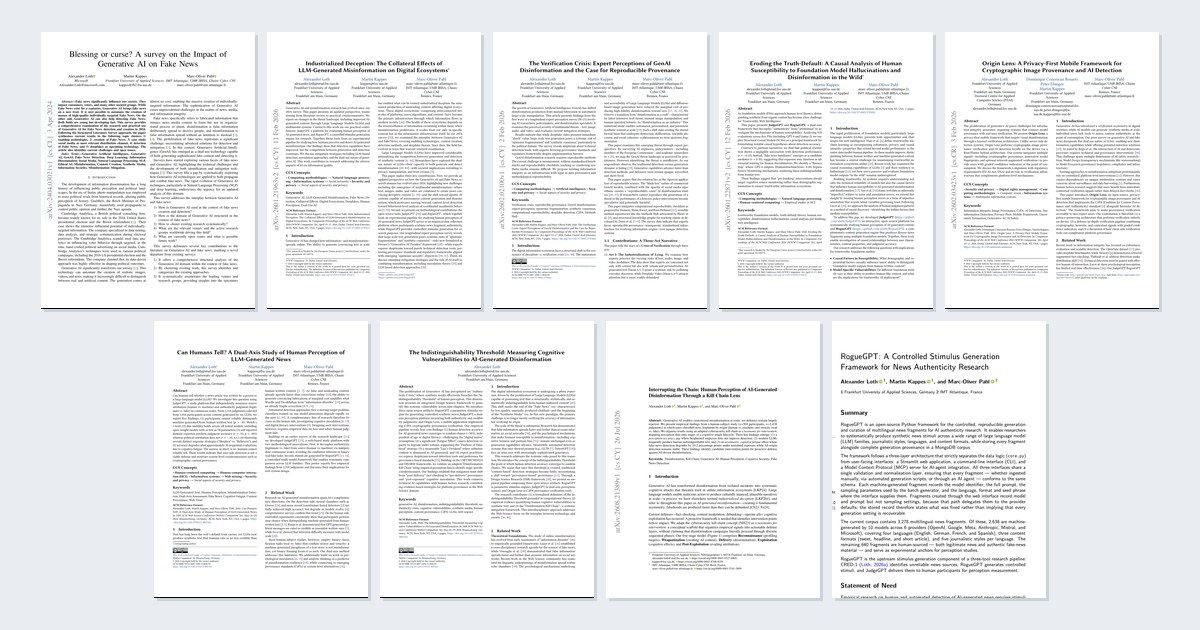
- Interrupting the Chain: Human Perception of AI-Generated Disinformation Through a Kill Chain Lens (post on the kill chain paper)
- RogueGPT as Agentic Infrastructure: Seeding Cross-Lingual Misinformation Simulations and Red-Teaming Social Media Agents
- WebSci ’26, the ACM Web Science Conference (Companion Publication)
- Can Humans Tell? A Dual-Axis Study of Human Perception of LLM-Generated News (post on the WebSci poster)
- Origin Lens: Reclaiming Trust on the AI-Mediated Web Through On-Device Image Provenance Verification, with Dominique Conceicao Rosario and Peter Ebinger
- The Indistinguishability Threshold: Measuring Cognitive Vulnerabilities to AI-Generated Disinformation, PhD Symposium, single-author (post on the PhD Symposium paper)
- WWW ’26, the ACM Web Conference (Companion Proceedings)
- Industrialized Deception: The Collateral Effects of LLM-Generated Misinformation on Digital Ecosystems (post on industrialized deception)
- Eroding the Truth-Default: A Causal Analysis of Human Susceptibility to Foundation Model Hallucinations and Disinformation in the Wild (post on the truth-default study)
- The Verification Crisis: Expert Perceptions of GenAI Disinformation and the Case for Reproducible Provenance (post on the verification crisis)
Unless noted otherwise, the coauthors are Martin Kappes and Marc-Oliver Pahl.
Preprints
- Blessing or Curse? A Survey on the Impact of Generative AI on Fake News, the literature survey that started the project (post on the literature survey)
- CRED-1: An Open Multi-Signal Domain Credibility Dataset for Automated Pre-Bunking of Online Misinformation on SSRN (post on the CRED-1 preprint)
Tools
- RogueGPT generates news fragments with many language models under documented conditions and stores the provenance of each one. GitHub
- JudgeGPT collects human judgments on two axes: written by a human or a machine, and legitimate or fake. GitHub
- Origin Lens checks C2PA content credentials and other signals of an image on an iPhone or iPad, on the device. App Store, GitHub
- CRED-1 is an open credibility dataset for news domains, also available as the npm package @aloth/cred1. GitHub
More on the tools: JudgeGPT and RogueGPT, their version 1.0 launch, Origin Lens, Introducing CRED-1, and how CRED-1 ended up in a Safari extension.
Data
- The RogueGPT stimulus corpus, the JudgeGPT perception data, and the expert survey responses are on Zenodo, with access for academic research on request: 10.5281/zenodo.18703137, 10.5281/zenodo.18703384, 10.5281/zenodo.18703600. Background in Three Open Datasets on AI-Driven Disinformation.
- The replication data for the Misinformation Review paper are openly available on Harvard Dataverse: 10.7910/DVN/BXO2QA.
- CRED-1 is openly available under CC BY 4.0: 10.5281/zenodo.18769459.
- The expert survey instrument is on GitHub: aloth/verification-crisis.
Background
How the topic came about:
- Joining Microsoft’s AI for Good Lab (2021)
- Data, Disinformation, and the War in Ukraine (2022)
- How ChatGPT Changes the Disinformation Problem (2023)
- A New Role at Microsoft and the Start of My PhD (2024)
- How to Spot Fake News This Election (2024), with an early version of the JudgeGPT quiz
- From CERN Grid Computing to AI Disinformation Research
- From Misinformation to Agentic AI: Where My Research Is Heading
All publications, including my books and earlier work, are on the Research page.
If you work on these questions and want to use the data or compare results, get in touch.

