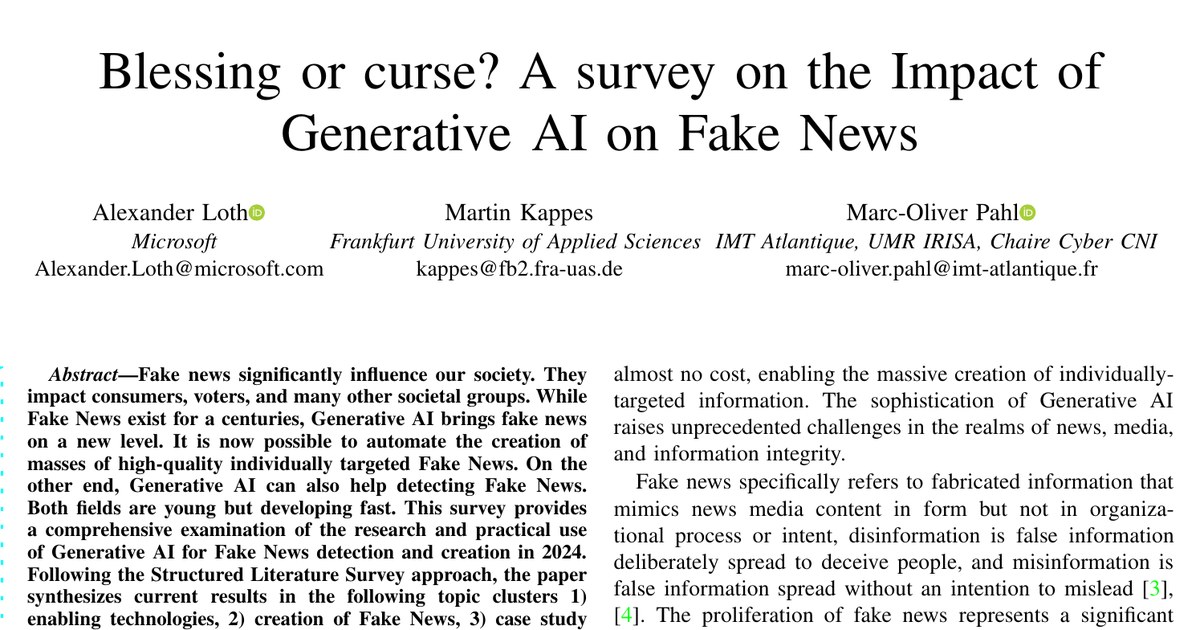
The first paper from my doctoral research is online. “Blessing or Curse? A Survey on the Impact of Generative AI on Fake News”, written with Martin Kappes and Marc-Oliver Pahl, appeared on arXiv on April 3. We have submitted it to ACM Transactions on Intelligent Systems and Technology (TIST).
Why start with a survey
Generative AI cuts both ways for fake news. It can automate the creation of masses of high-quality, individually targeted fake news. It can also help detect fake news. Both research fields are young and developing fast, and the literature has yet to fully explore where they meet. Before running studies of our own, we wanted a map of where the field stands. It is also the first step I described when I started my PhD in January.

Decisively Digital
Discover the power of artificial intelligence and digital transformation in the #1 best-selling business book Decisively Digital.
Buy on Amazon Learn MoreFrom retouched photos to generated news
The paper opens with history. Under Stalin, photo manipulation erased political rivals from the record. The Cambridge Analytica case, tied to the 2016 US presidential election and the Brexit referendum, showed the potential of individually targeted information, at a time when that political advertising was still crafted by hand. Generative AI removes that bottleneck: realistic text, images, and videos can now be generated at almost no cost.
What the survey covers
Following the structured literature survey approach, we sort current research into five clusters:
- Enabling technologies
- Creation of fake news
- Social media as the most relevant distribution channel, as a case study
- Detection of fake news
- Deepfakes as an upcoming technology
The survey also lists the venues and research groups that drive the field and identifies open issues.
Open issues
A few findings shape what comes next for me:
- An arms race. Generative AI and detection countermeasures keep chasing each other, and this race points to a significant research gap.
- Fast change, little data. The rapid evolution of generative AI, ethical concerns, and a scarcity of comprehensive datasets are among the main challenges.
- A gap at the intersection. The literature has yet to fully explore where generative AI and fake news meet, partly because the technologies are new and their misuse is hard to predict.
- More than technology. Future studies should focus on simulative research, cross-domain analysis, and both technological and social countermeasures. The mitigation work we reviewed points the same way: psychological approaches such as inoculation theory, design principles for generative AI, and collaboration among governments, the private sector, and civil society belong in the picture alongside detection algorithms.
For me, the data gap stands out. Before anyone can measure how well people or machines recognize AI-generated news, the field needs open, reusable datasets and tools, and that is where I want our own studies to contribute.
Read the paper
- arXiv: 2404.03021
- Authors: Alexander Loth (Microsoft), Martin Kappes (Frankfurt University of Applied Sciences), Marc-Oliver Pahl (IMT Atlantique, Chaire Cyber CNI)
@misc{loth2024blessing,
  title         = {Blessing or Curse? A Survey on the Impact of Generative AI on Fake News},
  author        = {Loth, Alexander and Kappes, Martin and Pahl, Marc-Oliver},
  year          = {2024},
  eprint        = {2404.03021},
  archivePrefix = {arXiv},
  primaryClass  = {cs.CL}
}
If you work on fake news detection, generative AI, or platform policy, I would like to hear which gaps you see, and which work we missed.

