Our research note “Experts Disagree on How to Fight AI Disinformation, but Agree That Health and Politics Need Different Solutions” is out today in the Harvard Kennedy School Misinformation Review. Martin Kappes, Marc-Oliver Pahl, and I report an expert survey on AI-generated disinformation.
The survey
Between July 2025 and March 2026, 54 experts answered our online survey. We invited 454 people through targeted recruitment and snowball referrals, a response rate of 11.9%. Respondents rated four modalities (text, images, audio, video) in four domains (political, health, financial, social) and five mitigation strategies. A first wave with 21 experts appeared earlier this year at WWW ’26 as The Verification Crisis.

Decisively Digital
Discover the power of artificial intelligence and digital transformation in the #1 best-selling business book Decisively Digital.
Buy on Amazon Learn MoreThreats depend on the domain
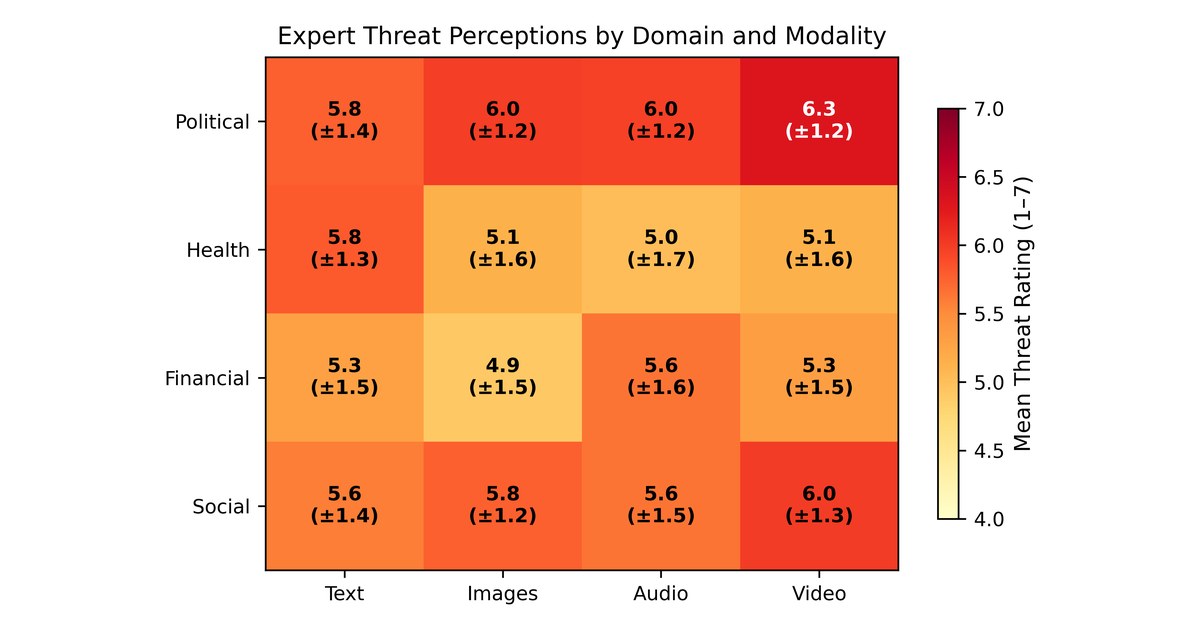
Across all domains, video deepfakes received the highest average threat rating (6.19 on a 7-point scale), followed by audio (5.91), images (5.74), and text (5.57). The averages hide differences between domains:
- Politics: video was rated highest (6.31). Its confidence interval overlaps with audio, so with 54 respondents the order is suggestive.
- Health: text was rated highest (5.80). The other three modalities were rated lower, between 5.02 and 5.13, with overlapping confidence intervals.
- Finance: audio deepfakes were rated highest (5.65), which fits reports of voice-cloning fraud.
78% named election interference through deepfake video as the most urgent risk.
Countermeasures: agreement on value, disagreement on priority
The five strategies were government regulation, digital watermarking, media literacy, platform enforcement, and technical detection. Asked to rate them, experts endorsed all five: between 63% (technical detection) and 74% (government regulation) gave a rating of 5 or higher, and none of the distributions had two peaks.
Asked to pick the most and least effective strategy, they split. Government regulation drew 30% of the “most effective” votes and 15% of the “least effective” votes. Media literacy drew 26% and 24%. The experts agree that each strategy can contribute. They disagree on which should come first.
One gap: psychological inoculation, or pre-bunking, was not among the five strategies we asked about, and no respondent brought it up. The research on it suggests it deserves a place in this debate.
What follows
Because no single strategy has a consensus, the paper argues for a combination, weighted by domain. Grouped by what they act on, the strategies form four pillars: provenance (the content), literacy (the audience), regulation (the producers), and platform enforcement (distribution). The entry points differ by domain: provenance for political video, labeling and medical fact-checking for health text, voice authentication and modernized identity checks for financial audio, and literacy that reaches people who are not already tech-savvy for the social domain.
This priority matrix is derived from expert perceptions. We present it as a hypothesis to test.
Read the paper and the data
- Paper: doi.org/10.37016/mr-2020-205
- Replication materials on Harvard Dataverse: doi.org/10.7910/DVN/BXO2QA
Thanks to all 54 experts who took the time to answer, and to the editors and reviewers of the Misinformation Review.

