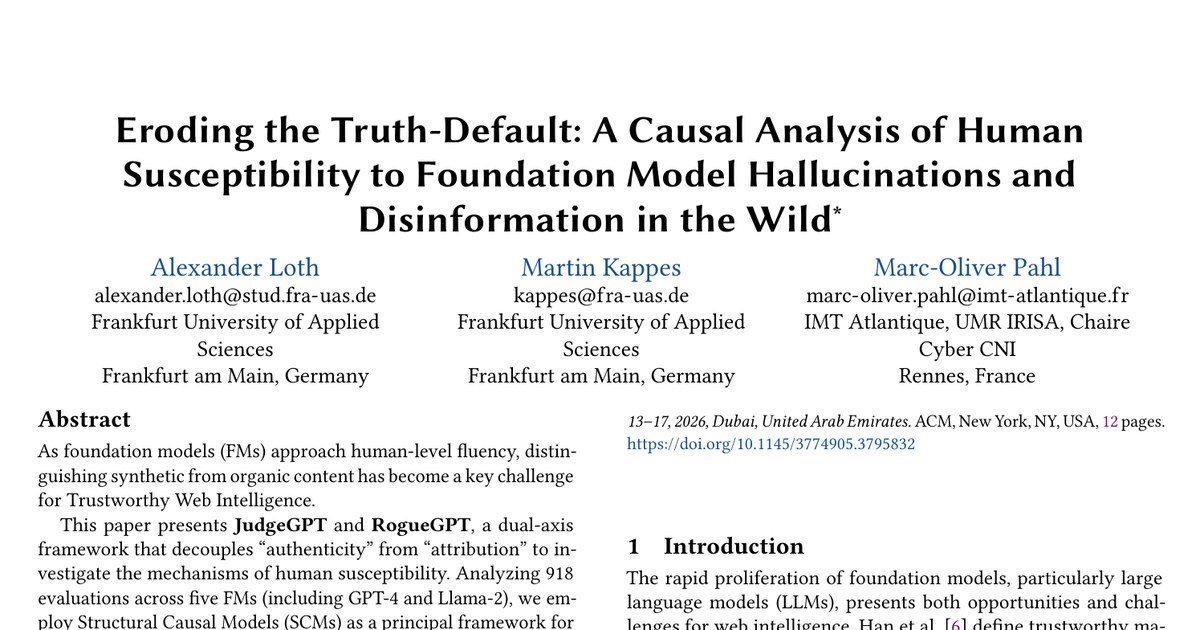
Our paper “Eroding the Truth-Default: A Causal Analysis of Human Susceptibility to Foundation Model Hallucinations and Disinformation in the Wild” is now published in the Companion Proceedings of the ACM Web Conference 2026 (WWW ’26). Martin Kappes, Marc-Oliver Pahl, and I analyze the responses collected with JudgeGPT, our open survey platform.
The setup
JudgeGPT shows participants short news fragments, generated with RogueGPT or taken from real news, and asks two separate questions: was this written by a human or a machine, and is it legitimate or fake? Participants also report demographics and how familiar they are with fake news.

Decisively Digital
Discover the power of artificial intelligence and digital transformation in the #1 best-selling business book Decisively Digital.
Buy on Amazon Learn MoreThe analysis uses the data as of December 2025. After we excluded 95 early participants whose responses used an earlier format, it covers 154 participants and 918 evaluations of fragments from five models, including GPT-4 and Llama-2.
What we found
- Familiarity with fake news goes with better judgments. It correlates with accuracy in attributing the source (r = 0.35) and in judging legitimacy (r = 0.29).
- Political orientation does not. The associations are weak (r = -0.10 for source, r = -0.05 for legitimacy).
- GPT-4 text reads as the most human. On a score where lower means more human-like, GPT-4 averaged 0.20. The next model was at 0.44.
- People could not tell the groups apart. In aggregate, ratings for human-written and AI-generated fragments did not differ significantly.
Why “truth-default”
The title refers to Truth-Default Theory: people tend to assume that what they read is honest. The paper argues that fluent model output may erode that default. It also describes a “fluency trap”: readers judge where a text comes from by cues such as fluency and detail rather than by verified source information. In our data, GPT-4 output was the most likely to be taken for human writing.
A note on causality
We frame the results with a structural causal model to state hypotheses that can be tested. One example: the model used affects whether readers detect machine authorship, and the effect runs through how fluent the text appears. The data are observational, so the correlations are hypotheses for randomized experiments, not established causal effects.
What it suggests
If familiarity with fake news matters more than political orientation, pre-bunking that trains how people judge sources may help more than interventions aimed at political groups. That, too, is a hypothesis that needs an experiment.
Read and take part
- Paper: doi.org/10.1145/3774905.3795832
- Preprint: arXiv:2601.22871
- Code: JudgeGPT and RogueGPT on GitHub
- Survey: judgegpt.streamlit.app
The same proceedings include Industrialized Deception, which places these tools in the wider picture, and The Verification Crisis, our expert survey.

