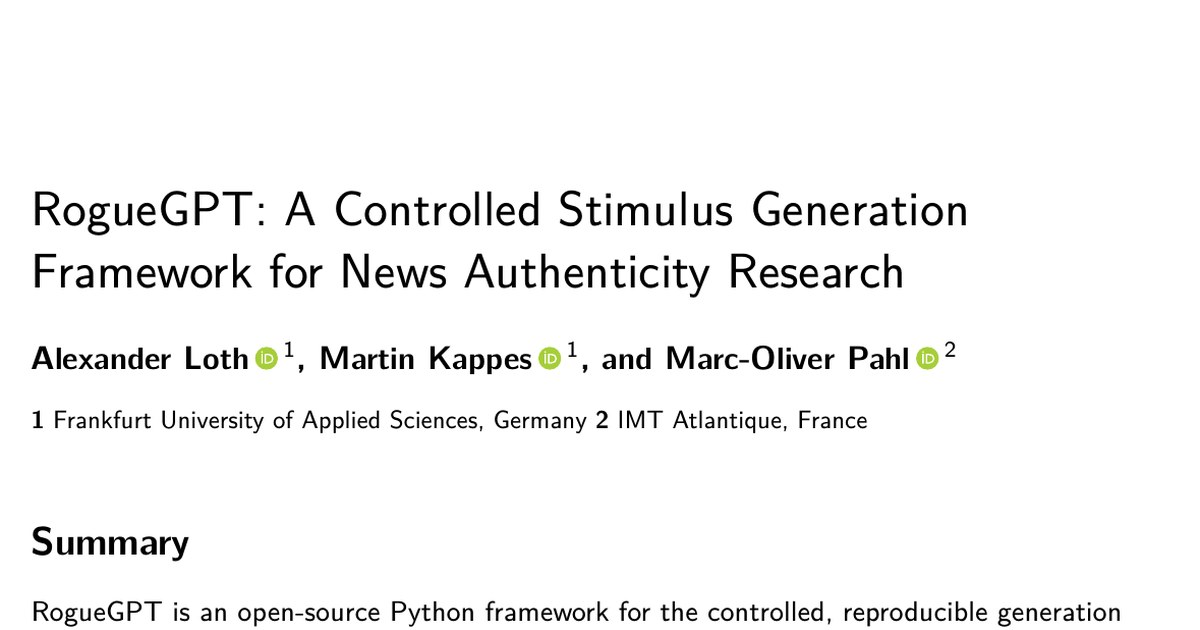
Today the Journal of Open Source Software (JOSS) published our paper “RogueGPT: A Controlled Stimulus Generation Framework for News Authenticity Research”, written with Martin Kappes and Marc-Oliver Pahl. JOSS reviews the software along with the paper: reviewers install it, check that it does what the paper says, and look at the documentation and tests.
What RogueGPT does
RogueGPT generates and curates multilingual news fragments for research on AI-generated news. Each fragment is stored with its provenance: the model, the full prompt, the sampling parameters used by the batch generator, and the language, format, and seed phrase where the interface supplies them. Fragments created in the web interface record model and prompt but not the sampling settings, because that path uses the provider defaults. The paper states this so that nobody assumes every setting can be recovered.

Decisively Digital
Discover the power of artificial intelligence and digital transformation in the #1 best-selling business book Decisively Digital.
Buy on Amazon Learn MoreThe code has three layers. A core module holds the data logic. On top of it sit a Streamlit web app, a command-line interface, and a Model Context Protocol (MCP) server for AI agents. All three share one validation layer, so a fragment has the same schema no matter how it entered the corpus.
The corpus
The current corpus has 3,278 news fragments:
- 2,638 machine-generated by 10 models from 6 providers (OpenAI, Google, Meta, Anthropic, Mistral, and Microsoft),
- in four languages (English, German, French, and Spanish),
- in three formats (tweet, headline, and short article), and five journalistic styles per language.
The other 640 fragments are human-sourced, both legitimate news and authentic fake news, and serve as anchors in perception studies.
Existing corpora are often static snapshots from one model or a few. RogueGPT is designed to grow: the MCP server offers ingest_fragment and retrieve_fragments as tools, so an agent can add outputs from new models as they are released.
Part of a pipeline
RogueGPT sits in the middle of three tools. CRED-1 identifies unreliable source domains, from which the human-written fake-news anchors come. RogueGPT generates the stimuli. JudgeGPT shows them to participants and records their judgments. The paper lists the publications that use RogueGPT so far and notes that all of them come from our own research program.
Access to the data
The corpus is on Zenodo with restricted access, granted on request to researchers at academic or non-profit institutions. There are two reasons. The human-sourced fragments are excerpts of third-party news that we cannot license onward; they are shared under the research exception for text and data mining. And a corpus of misinformation-like material should not circulate without an accountable requester.
The review
We submitted the paper on June 13. The review ran openly on GitHub, in openjournals/joss-reviews#11219. Thanks to our editor, Chris Vernon, and to the reviewers, @dosvk and @prajwal-svm, for their reviews.
Links
- Paper: doi.org/10.21105/joss.11219
- Code: github.com/aloth/RogueGPT (GPL-3.0-or-later)
- Archived release v1.4.2: doi.org/10.5281/zenodo.22666134
If you use RogueGPT in your own work, please cite the JOSS paper. Issues and pull requests are welcome.

