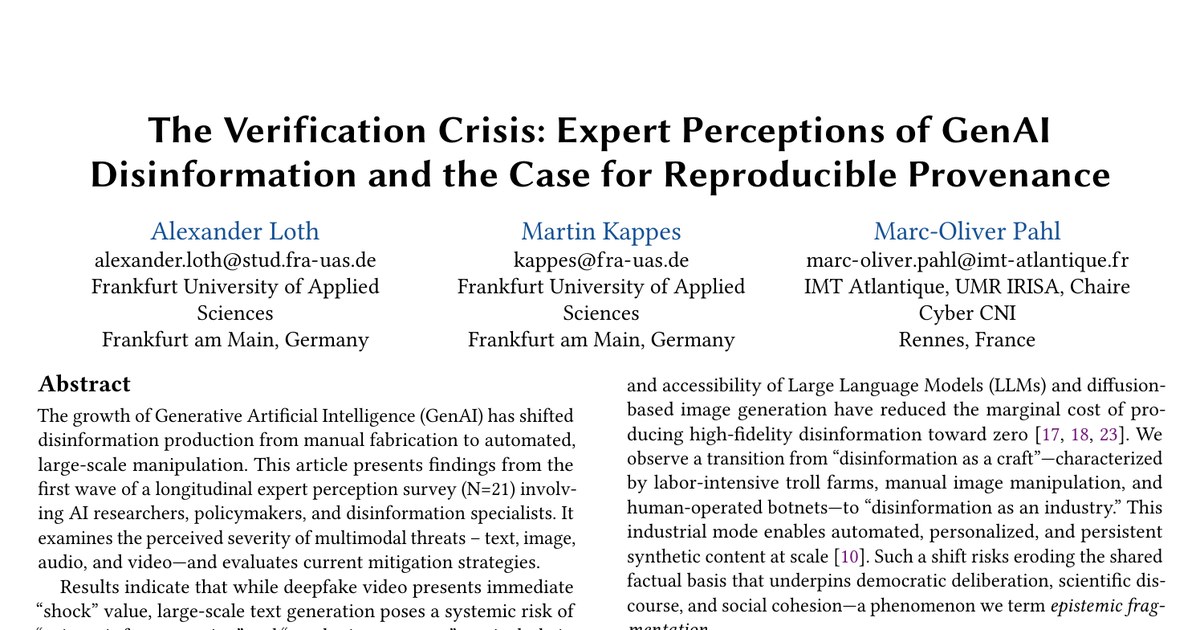
Our paper “The Verification Crisis: Expert Perceptions of GenAI Disinformation and the Case for Reproducible Provenance” is now published in the Companion Proceedings of the ACM Web Conference 2026 (WWW ’26). Martin Kappes, Marc-Oliver Pahl, and I wrote it for R2CASS, a workshop on reproducible and reusable computational approaches.
The survey
The paper reports the first wave of an expert survey on generative AI and disinformation. 21 experts took part: AI researchers and engineers, policymakers, journalists and civil society representatives, and industry executives. We recruited them through purposive snowball sampling, so the sample favors depth over statistical power, and it is predominantly European. Respondents rated the threat of four modalities and the effectiveness of five countermeasures on 7-point scales, and explained their ratings in free text.

Decisively Digital
Discover the power of artificial intelligence and digital transformation in the #1 best-selling business book Decisively Digital.
Buy on Amazon Learn MoreThreats
Mean threat ratings:
- Deepfake video: 6.4
- AI-generated text: 6.1
- Voice cloning: 5.9
- AI-generated images: 5.8
Video received the highest rating, but the free-text answers described text as the systemic risk. A single deepfake video is an event that can be debunked. Text runs through comments, reviews, articles, and posts, and generated text at scale can create the impression of a consensus. One AI researcher put it this way: “Personalized 1:1 persuasion via text is a bigger threat to democracy than a fake video which can be debunked.”
Countermeasures
Mean effectiveness ratings:
- Media and public literacy: 4.8
- Digital watermarking and C2PA: 4.2
- Government regulation: 4.1
- Platform enforcement: 3.5
- Technical detection tools: 3.4
Detection tools came last. Respondents described a cat-and-mouse dynamic, and the paper connects the low confidence to a reproducibility problem: when a detector cannot be inspected or rerun on new data, its claims cannot be checked. Provenance standards scored higher, although respondents pointed out that metadata can be stripped and that coordination is a massive challenge.
The case for reproducible provenance
The paper’s argument follows from these ratings. If researchers cannot reproduce how a threat was generated or how a detector performed, policy rests on claims that nobody can verify. We draw on reproducibility checklists for computational social science and on shared method repositories such as the Methods Hub, and we propose treating information integrity as infrastructure, with documented data provenance and reproducible methods.
Materials
- Paper: doi.org/10.1145/3774905.3795484
- Preprint: arXiv:2602.02100
- Survey instrument: github.com/aloth/verification-crisis
- Response data: on Zenodo, described in Three Open Datasets on AI-Driven Disinformation
Two companion papers appear in the same proceedings: Industrialized Deception and Eroding the Truth-Default.
This is a first wave with 21 respondents, so the numbers describe this group, not the field as a whole.

