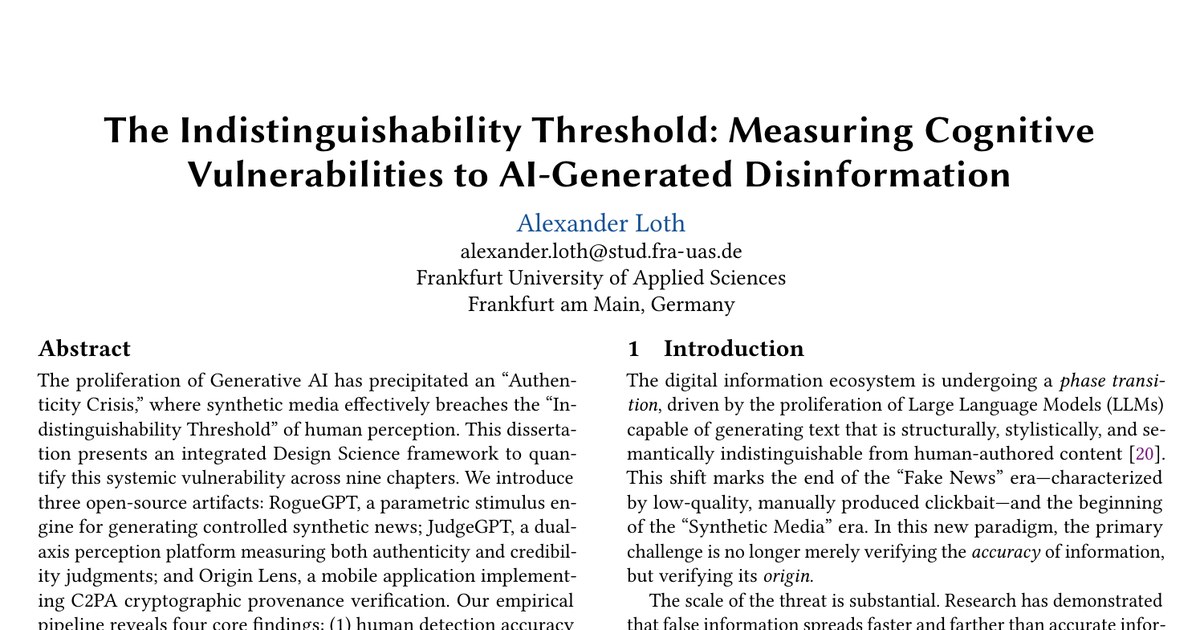
My paper for the PhD Symposium of the ACM Web Science Conference 2026 (WebSci ’26) is now published: “The Indistinguishability Threshold: Measuring Cognitive Vulnerabilities to AI-Generated Disinformation”. It is a four-page overview of my doctoral project at Frankfurt University of Applied Sciences.
The idea
The paper borrows a concept from cryptography. There, two distributions are computationally indistinguishable when no efficient test can tell them apart. Applied to people, the Indistinguishability Threshold is the point at which readers can no longer tell human-written from AI-generated text better than chance.

Decisively Digital
Discover the power of artificial intelligence and digital transformation in the #1 best-selling business book Decisively Digital.
Buy on Amazon Learn MoreFor short news formats such as tweets and headlines, our perception data put aggregate detection accuracy at 52%, statistically indistinguishable from guessing. Once the threshold is crossed, asking readers to spot fakes stops being a reliable defense, and the focus has to move to provenance: verifying where content comes from.
Research questions
The main question is to what extent the ecosystem of AI-driven disinformation, from generation to human perception, reveals new vulnerabilities and requires new mitigation frameworks. Four sub-questions break it down:
- Generation: how language models can be used systematically to generate news for research.
- Public perception: how non-experts judge AI-generated text, and which factors predict accuracy.
- Expert perception: how experts assess threats and countermeasures, and where they agree or disagree with the public data.
- Mitigation: which countermeasures fit which stage of a disinformation campaign.
Four artifacts
The project builds four open artifacts:
- RogueGPT generates news stimuli under controlled conditions.
- JudgeGPT measures whether people think a text is human or machine-written, and whether it is true or false.
- Origin Lens verifies C2PA content credentials on the device.
- CRED-1 provides credibility signals for news domains.
First results
- Volume wears people down. Detection accuracy declines as a session gets longer, which fits a strategy of flooding people with content.
- Different ages, same result. Participants aged 18 to 24 did no better than those aged 60 and over.
- The reverse error. Separating the two questions also shows authentic content being dismissed as AI-generated.
The paper also proposes a kill chain for AI-driven disinformation with five stages (reconnaissance, weaponization, delivery, exploitation, impact) and assigns a countermeasure to each stage.
Next steps
The paper lists five directions: audio and video, cross-cultural studies, pre-bunking interventions, adoption of provenance standards, and further work on CRED-1.
Read the paper
- Paper (open access, CC BY 4.0): doi.org/10.1145/3795513.3807421
- The project’s starting point: Blessing or Curse?
Thanks to my supervisors, Martin Kappes and Marc-Oliver Pahl.

