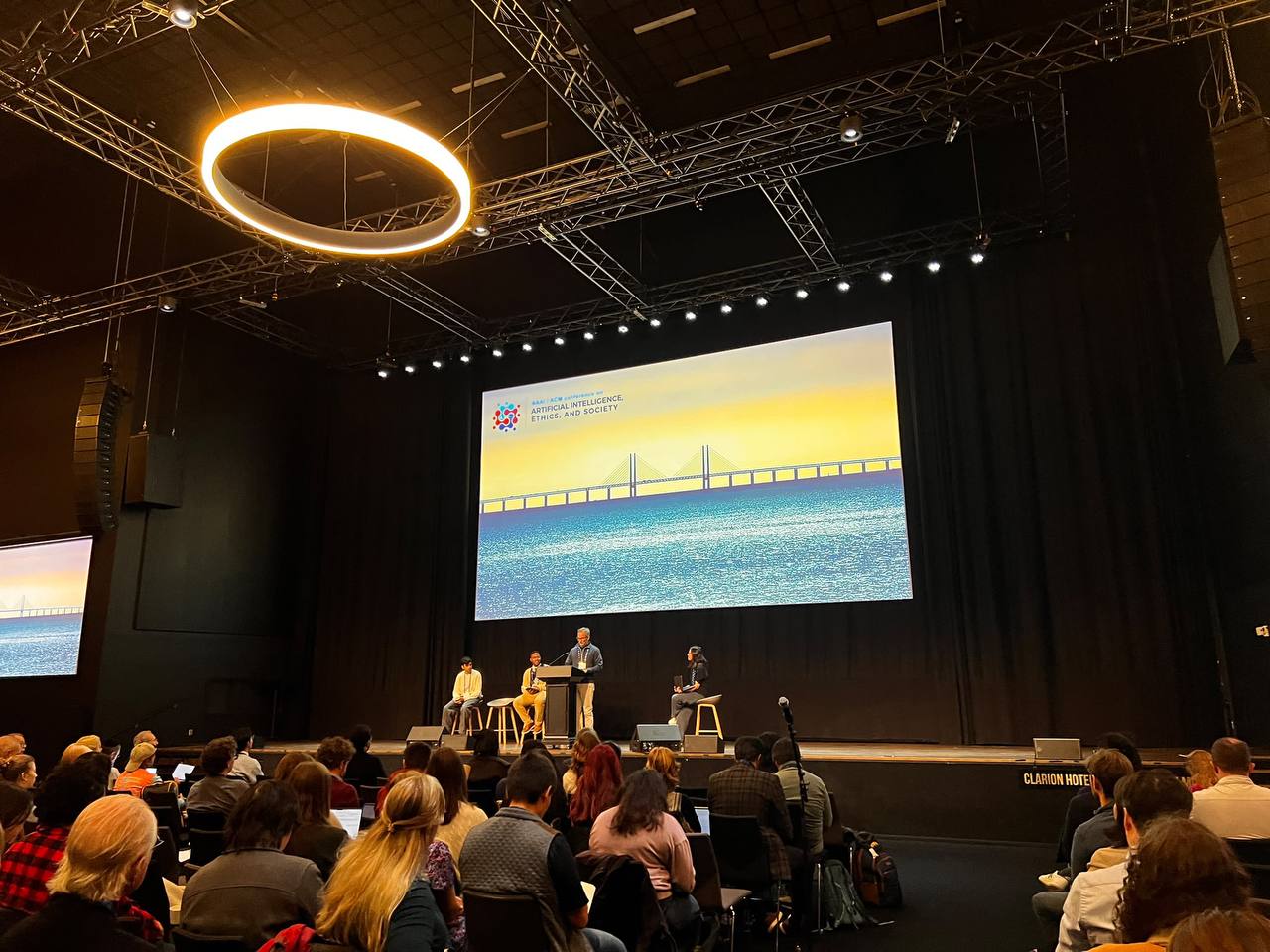
This morning at the AAAI/ACM Conference on AI, Ethics, and Society (AIES 2026) in Malmö, I presented The Mitigation Paradox: How AI-Disinformation Experts Converge on Threats but Polarize on Solutions, joint work with Mina Schütz, Martin Kappes, and Marc-Oliver Pahl. The paper was part of Discussion Session 1 on Participation, Sovereignty, and Power in AI Governance, chaired by Haiyi Zhu.
The format was a real discussion, not four talks in a row. After short summaries, each team’s framework was applied to another team’s cases. Here are the three points I took away.
1. Experts agree on the threat
We surveyed 54 experts in 21 countries between July 2025 and March 2026. 78% name election deepfake videos as the most urgent risk. On how serious the threat is, the field largely converges.
2. They split on the cure
Government regulation is the most-chosen “most effective” strategy, at 30%. Yet 15% of the same experts rate it the least effective. Media literacy shows a similar pattern: the ratings form two camps rather than one uncertain middle. An average hides this. A mean of “fairly effective” can describe a panel in which almost nobody holds that view.

3. Match the instrument to the shape of the disagreement
Our paper translates patterns of expert disagreement into four policy actions:
- Bind: where experts converge, as on deepfake severity, regulate, evaluate, and resource.
- Pilot: where ratings split into two camps, as on media literacy, test first, with sunset clauses.
- Differentiate: where regions disagree, as on regulation and detection, let jurisdictions choose different instruments.
- Monitor: where signals are weak, as on emerging risks, watch and ask again later.
The chair asked how research can help policymakers. My answer: show the structure of disagreement, not just the average. Treat disagreement as a design input, not as a reason to wait.
What connected the four papers
The other papers looked at synthetic agents in participatory processes, cognitive digital twins, and sovereign AI. A common thread was the participation paradox: real participation is slow and expensive, which makes shortcuts tempting. Our data suggest one risk of such shortcuts. A synthetic panel would likely have reproduced the average and erased the split, and the split was our finding.
Thanks to Haiyi Zhu for chairing and to my fellow panelists for the discussion.
Read the paper
- Published paper (AIES 2026 proceedings): doi.org/10.1609/aies.v9i3.43261
- Preprint: doi.org/10.5281/zenodo.23302284
- Survey data: doi.org/10.5281/zenodo.18703600
- Survey instrument: github.com/aloth/verification-crisis

