Tag: Research
-
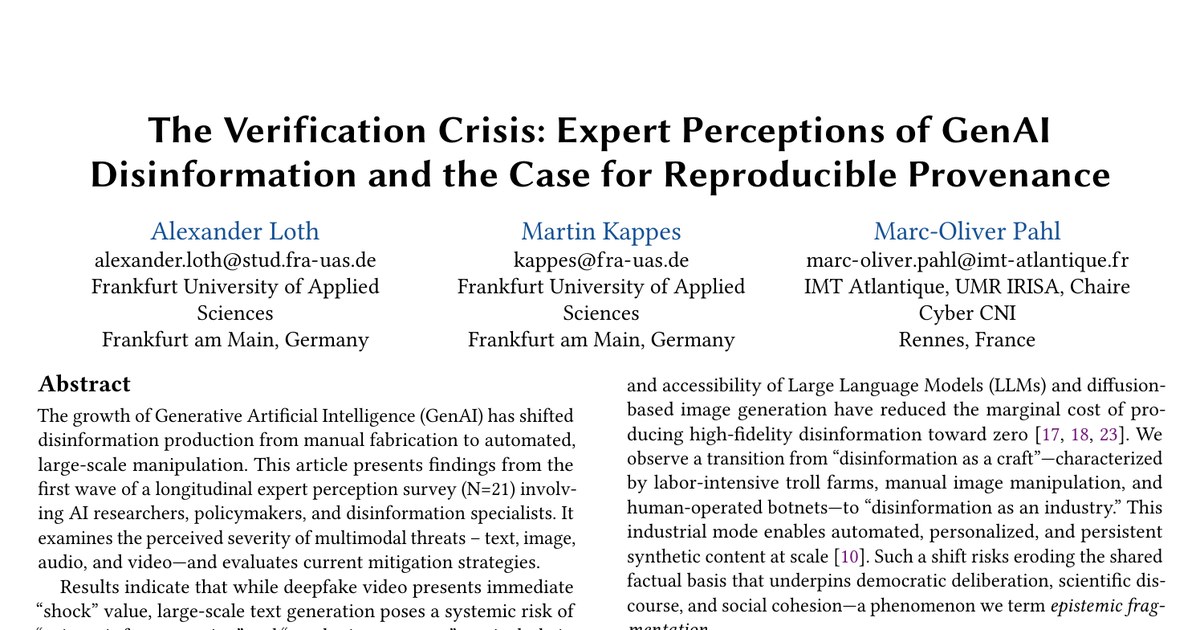
The Verification Crisis: What 21 Experts Say About GenAI Disinformation
Our paper “The Verification Crisis: Expert Perceptions of GenAI Disinformation and the Case for Reproducible Provenance” is now published in the Companion Proceedings of the ACM Web Conference 2026 (WWW ’26). Martin Kappes, Marc-Oliver Pahl, and I wrote it for R2CASS, a workshop on reproducible and reusable computational approaches. The survey The paper reports the…
-
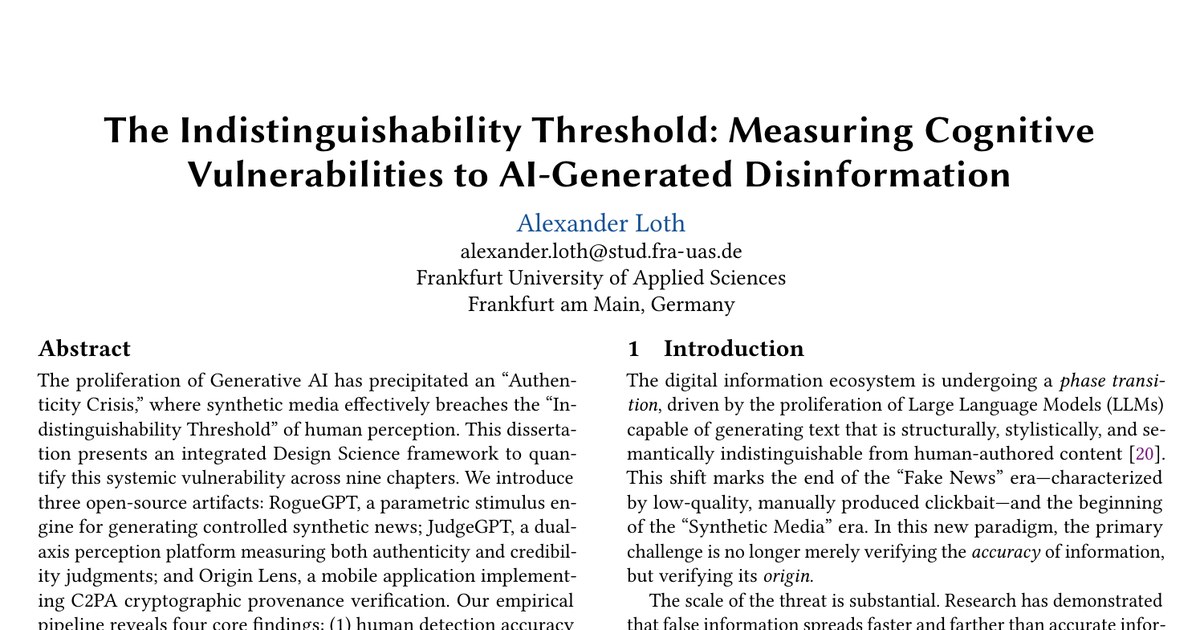
The Indistinguishability Threshold: My PhD Symposium Paper at WebSci ’26
My paper for the PhD Symposium of the ACM Web Science Conference 2026 (WebSci ’26) is now published: “The Indistinguishability Threshold: Measuring Cognitive Vulnerabilities to AI-Generated Disinformation”. It is a four-page overview of my doctoral project at Frankfurt University of Applied Sciences. The idea The paper borrows a concept from cryptography. There, two distributions are…
-
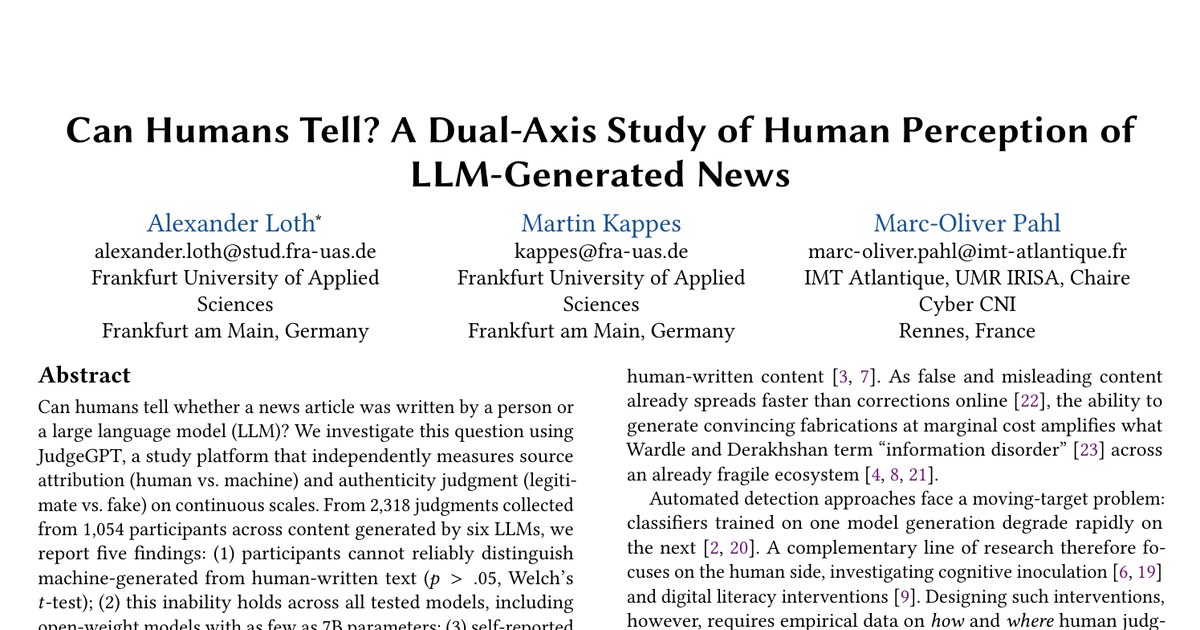
Can Humans Tell? Our WebSci ’26 Poster on Human Perception of AI-Written News
Can people tell whether a news text was written by a person or a language model? In our data, they cannot. Our poster paper “Can Humans Tell? A Dual-Axis Study of Human Perception of LLM-Generated News”, with Martin Kappes and Marc-Oliver Pahl, is now published in the Companion Publication of the ACM Web Science Conference…
-

CRED-1: An Open Multi-Signal Domain Credibility Dataset for Misinformation Pre-Bunking
I’m excited to share CRED-1, an open, reproducible domain-level credibility dataset that I’ve been working on as part of my doctoral research at Frankfurt University of Applied Sciences. The preprint is now available on SSRN, and the full dataset and pipeline are openly accessible on GitHub and Zenodo. What is CRED-1? CRED-1 provides credibility scores…
-

Introducing CRED-1: An Open Domain Credibility Dataset for Fighting Online Misinformation
How do you know whether a news source is trustworthy? That question is at the heart of my latest research project. Today, I am releasing CRED-1, an open multi-signal domain credibility dataset that assigns credibility scores to 2,672 domains known for publishing misinformation, conspiracy theories, or other unreliable content. Why Another Dataset? Existing source lists…

