Most people do not skip the gym because they lack motivation. They skip it because an hour feels like too much. Supersets are one of the simplest ways to fit the same work into less time. This guide explains what a superset is, which types exist, what research says about time and performance, when supersets make sense and when they do not, and how to set them up.
What is a superset?
A superset means doing two or more exercises back to back with little or no rest between them, then resting after the round. A 2021 review in Sports Medicine defines superset training (also called paired sets or compound sets) exactly that way. Instead of bench press, rest, bench press, rest, you do bench press, then a row, then rest, and repeat.
There are several common variants:
- Antagonist superset (paired set): two exercises for opposing muscle groups, for example a press and a pull. One muscle group works while the other recovers. This is the version most studies looked at.
- Unrelated or upper/lower superset: two exercises that barely overlap, such as a lunge and a pull-up. Similar logic, different muscles.
- Same-muscle superset (often called a compound set): two exercises for the same muscle, for example dumbbell press followed by push-ups. It adds fatigue to one muscle rather than saving time.
- Pre-exhaust: a special same-muscle superset where an isolation exercise comes first and a compound lift second, for example leg extensions before squats.
- Tri-sets and giant sets: three or more exercises in a row before the rest.
What the research says
The time savings are real. In a randomized crossover study by Weakley et al. (2017), 14 men did the same six exercises in three formats. The traditional session took about 42 minutes, the superset session about 24 minutes and the tri-set session about 18 minutes. Kilograms lifted per minute rose from about 275 to 483 with supersets and to 657 with tri-sets.
The trade-off: the superset and tri-set sessions felt harder, produced higher lactate levels, and jump performance was possibly to likely still reduced 24 hours later, while it had returned to baseline after the traditional session. The authors conclude that supersets and tri-sets enhance efficiency and reduce training time, but may need more recovery.
Volume does not have to suffer. In Robbins et al. (2010), 16 trained men alternated bench pulls and bench presses in about the same 10 minutes as the traditional format and achieved a higher volume load, which made the paired sets more efficient. Paz et al. (2017) found a similar pattern with bench press and seated row: more volume in less time, but also more muscle fatigue.
The Iversen review sums it up. Acute studies with agonist and antagonist pairs show that supersets can be done in roughly half the time of traditional training without reducing volume. The only longitudinal study with traditional exercises found similar strength gains after eight weeks, again with about half the training time. The authors also note that these techniques are probably better for muscle growth than for maximal strength, and that more long-term research is needed.
When supersets fit and when they do not
Supersets are a good choice when:
- You are short on time and want to keep your weekly volume.
- Your goal is general fitness or muscle growth.
- You train accessories, machines or dumbbells that are easy to set up next to each other.
They are a poor fit when:
- You train heavy compound lifts for maximal strength. A near-maximal squat or deadlift needs full focus and full recovery. Adding a second hard exercise in between mostly adds fatigue.
- The gym is crowded. Holding a bench and a cable station at the same time is not always possible or polite. Choose pairs you can do in one spot, such as dumbbell press and dumbbell row on the same bench.
- Technique is still new. Fatigue makes form worse. Learn a movement with straight sets first.
- You need the recovery. Weakley et al. saw longer lasting fatigue after supersets. Plan for it if the next session is demanding.
Four example pairings
- Push and pull: dumbbell bench press + one-arm dumbbell row.
- Vertical push and pull: overhead press + pull-ups or lat pulldown.
- Arms: biceps curl + triceps pushdown.
- Lower and upper body: Romanian deadlift + push-ups, or reverse lunges + inverted rows.
All four are antagonist or unrelated pairs, the type that saves the most time.
How long to rest
Inside the pair, rest only as long as it takes to switch stations. After the round, rest as you would after a normal set; Paz et al. used two minutes between rounds. A practical starting point is 1.5 to 3 minutes after each round, more for heavier pairs and less for light accessory pairs. If your reps drop sharply from round to round, rest longer.
How to run supersets in Mindful Body

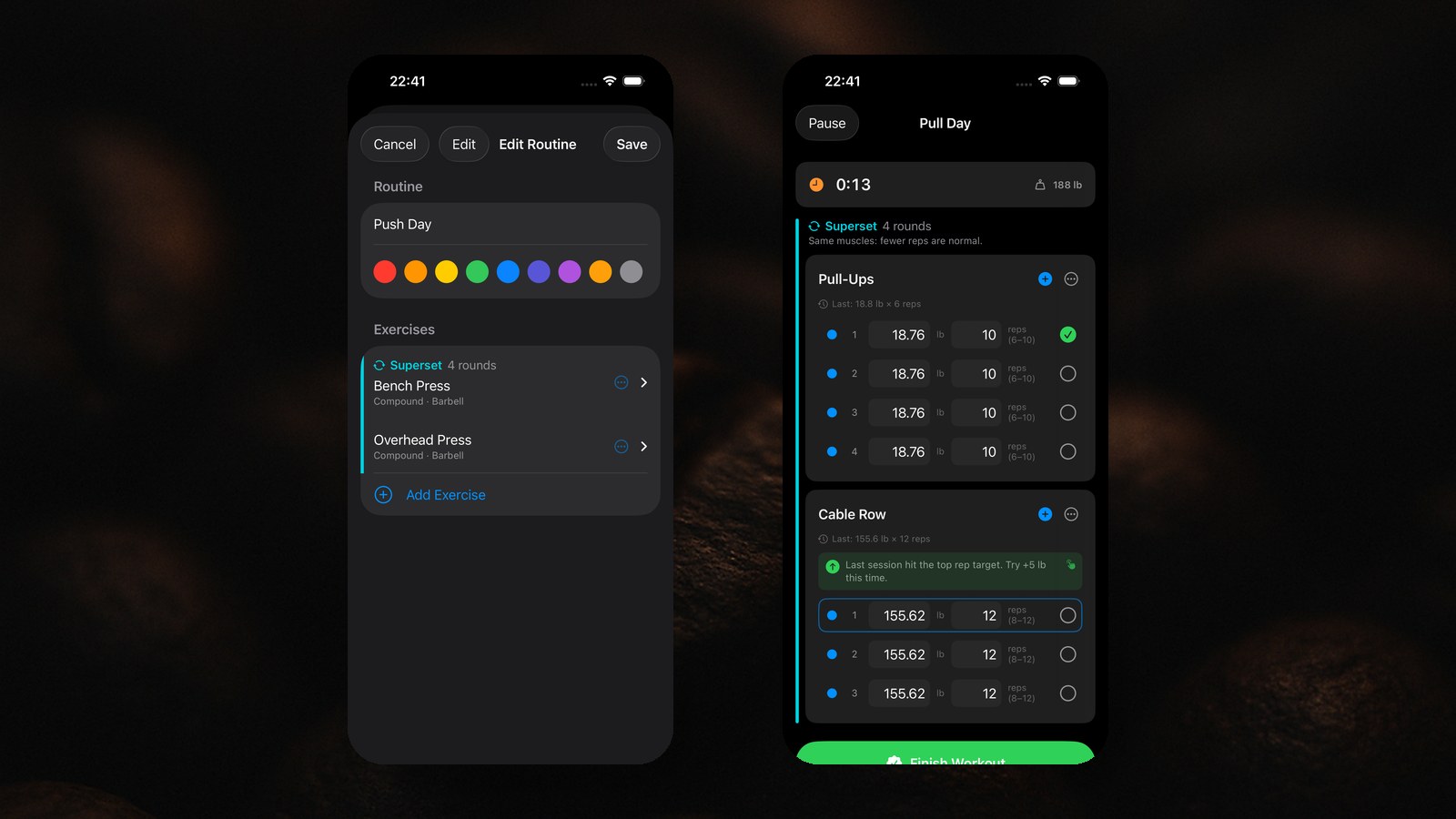
Version 6.3 of Mindful Body, my workout and body composition tracker, added supersets, so you no longer need to keep the order in your head. During a workout, tap “…” on an exercise card, choose “Create Superset…” and select two or more exercises; you can group a pair, a tri-set or up to four exercises. The same option sits in the “…” menu of each exercise in the routine builder, where the superset is saved with the routine. A superset created during a workout applies to that workout only.

Grouped exercises sit under one colored bar with a “Superset” header and the number of rounds. Your sets alternate (A1, B1, A2, B2) with no rest in between, the rest timer starts after each round and names the exercise that comes next. If one exercise has more sets, it continues on its own. When the exercises train the same muscle group, a short hint reminds you that fewer reps are normal. More in the Mindful Body 6.3 release notes, or get Mindful Body on the App Store.
FAQ
Are supersets good for building muscle?
The Iversen review suggests that supersets can keep training volume while roughly halving training time, and that such techniques are probably better suited for muscle growth than for maximal strength.
Do supersets build strength?
The single longitudinal study in the review found similar strength gains to traditional sets over eight weeks. For maximal strength on heavy lifts, straight sets with full rest remain the safer choice.
How many exercises can a superset have?
Two is a classic superset, three is a tri-set, more is often called a giant set. More exercises save more time but also add more fatigue.
Can beginners do supersets?
Yes, with simple pairs and moderate weights. Learn new movements with straight sets first, then pair them once the technique is stable.
Try it in your next session
Pick one pair from the list above, keep your usual weights and rest after each round. You will likely finish noticeably sooner. To track the rounds and let the rest timer tell you what comes next, download Mindful Body on the App Store.

